Um percurso pela cidade, arquitetura, pesquisas, artigos e trabalhos acadêmicos que exploram como a cibernética e as tecnologias digitais podem ampliar conexões, qualificar espaços e aproximar as pessoas.
A journey through the city1, architecture2, research0, articles2 and academic papers0 that explore how cybernetics2 and digital technologies3 can expand connections, enhance spaces, and bring people closer together.

Gardens of Encounter
Pilot project for the living occupation of street space in Belo Horizonte
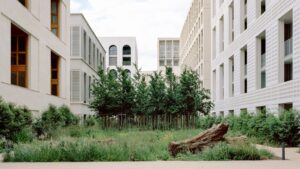
Encounter Gardens is a pilot project that proposes the transformation of parking spaces on public streets in Belo Horizonte into small living gardens. Occupied primarily by vegetation (between 80% and 90% of the area), they are designed for coexistence between humans and non-humans and for reconnecting the city with the earth.
The project stems from the understanding that the city is also a territory, and that greenery should not be treated as mere infrastructure, adornment, or functional support, but as a living presence with the right to exist, grow, and establish relationships within the urban space.
Instead of expanding seating or consumption areas, the Jardins de Encontro propose gestures of cohabitation: patches of earth that emerge through the asphalt and interrupt the exclusive logic of the automobile, creating places of shade, freshness, shelter, and biological diversity in the everyday life of the street.
Each garden is installed over existing parking spaces, complying with current municipal legislation for parklets (Varandas Urbanas), using removable and accessible structures. The layout prioritizes living soil, the planting of native species adapted to the local climate, and minimal occupation by paved surfaces—limited only to what is necessary for access, maintenance, and safety.
The Jardins de Encontro are not intended for the exclusive use of any establishment or group; they are recognized as freely accessible public spaces aimed at coexistence, observation, and informal lingering. Their primary role is not to offer furniture, but to offer life: plants, insects, birds, moisture, shade, and time.
As a pilot project, the initiative seeks to test new forms of green presence in the city, especially in contexts where traditional tree planting is hindered by narrow sidewalks, overhead wiring, or excessively compacted soils. By shifting the planting area to the lane previously designated for parking, the project explores new possibilities for reconnecting the street with nature.
The pilot anticipates the implementation of an initial set of Jardins de Encontro on low-speed streets, preferably in areas lacking urban tree cover, allowing for the observation of their microclimatic, ecological, and social effects over time.
More than a technical solution, the Jardins de Encontro constitute a sensitive urban experiment that invites the city to reconsider its relationship with public space, with the automobile, and with the forms of life that inhabit it.
2024