Um percurso pela cidade, arquitetura, pesquisas, artigos e trabalhos acadêmicos que exploram como a cibernética e as tecnologias digitais podem ampliar conexões, qualificar espaços e aproximar as pessoas.
A journey through the city1, architecture2, research0, articles2 and academic papers0 that explore how cybernetics2 and digital technologies3 can expand connections, enhance spaces, and bring people closer together.
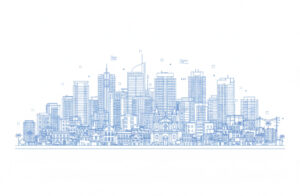
Beyond Data Mirrors
A Framework for Participatory Urban Digital Twins
Beyond Data Mirrors” proposes a cybernetic framework for Urban Digital Twins (UDTs) grounded in participatory governance rather than technocratic optimization. Drawing on Stafford Beer’s principles and lessons from Project Cybersyn, the paper develops five principles for UDTs to operate as variety engineering tools: distributed data governance, recursive decentralized coordination, algedonic signals for system feedback, interoperability through federated structures, and scenario simulation for collective learning. The central argument is that urban complexity is not a problem to be solved through algorithmic control, but a condition to be democratically navigated by citizens with amplified capacity for meaningful engagement.
Ver maisView more
2025
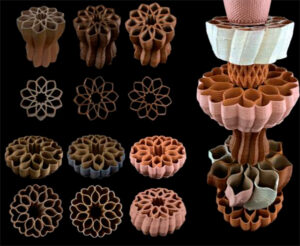
Digital Crafting
Parametric design, digital clay manufacturing, and traditional ceramic craftsmanship
Peper presented at Sigradi 2025 – Author – Heloisa Sudano & Mateus van Stralen
This paper presents a study that explored the intersection of parametric design, digital fabrication, and traditional Brazilian ceramic craftsmanship through culturally grounded, collaborative approaches. Adopting “digital vernacular” and “digital craftsmanship” concepts, the research merged tradition and innovation through a three-stage methodology: understanding parametric logic using Rhinoceros/ Grasshopper, clay behavior and ceramic 3D printing; engaging with Jequitinhonha Valley artisans through workshops; and creating parametric ceramic pieces informed by traditional knowledge. Results show that clay additive manufacturing can incorporate local materials and craft knowledge as design inputs, forming a “hybrid territory” between artisanal and digital practices. The workshops revealed potential for co-authorship through simplified parametric interfaces, allowing non-specialists to engage in digital creation. The study demonstrates that digital fabrication can serve as a tool for cultural valorization when used contextually, contributing to hybrid approaches that respect traditional practices while expanding creative possibilities through digital tools.
Ver maisView more
2025
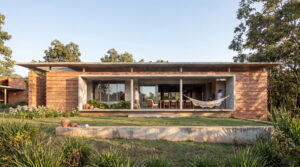
Janaúba House
The Janaúba House was conceived for a couple of friends on the shores of the Bico da Pedra Reservoir in northern Minas Gerais, Brazil. Organized along a continuous axis, the residence articulates small courtyards, outdoor living areas, the garage, the interior spaces, and a lookout facing the landscape. The architecture responds to the region’s climate, marked by hot and dry periods alternating with seasons of intense rainfall, through ceramic brick walls that protect the house from direct solar exposure and through a large roof that shelters both indoor and outdoor spaces, creating shade, protection, and spatial continuity. Gardens help moderate the internal temperature, while openings favor natural light and cross ventilation. Interior and exterior continuously merge throughout the experience of the house.
Ver maisView more
2025
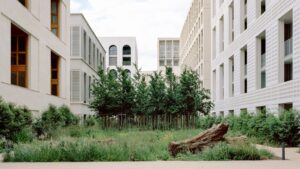
Gardens of Encounter
2024
River Rhythms
A speculative project investigating the daylighting and renaturalization of Belo Horizonte’s rivers and streams as futuring practices.
Ver maisView more

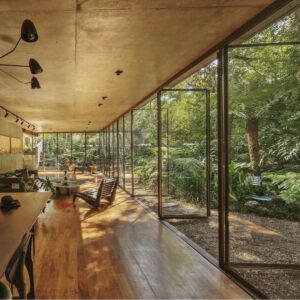
Lamounier House
2020